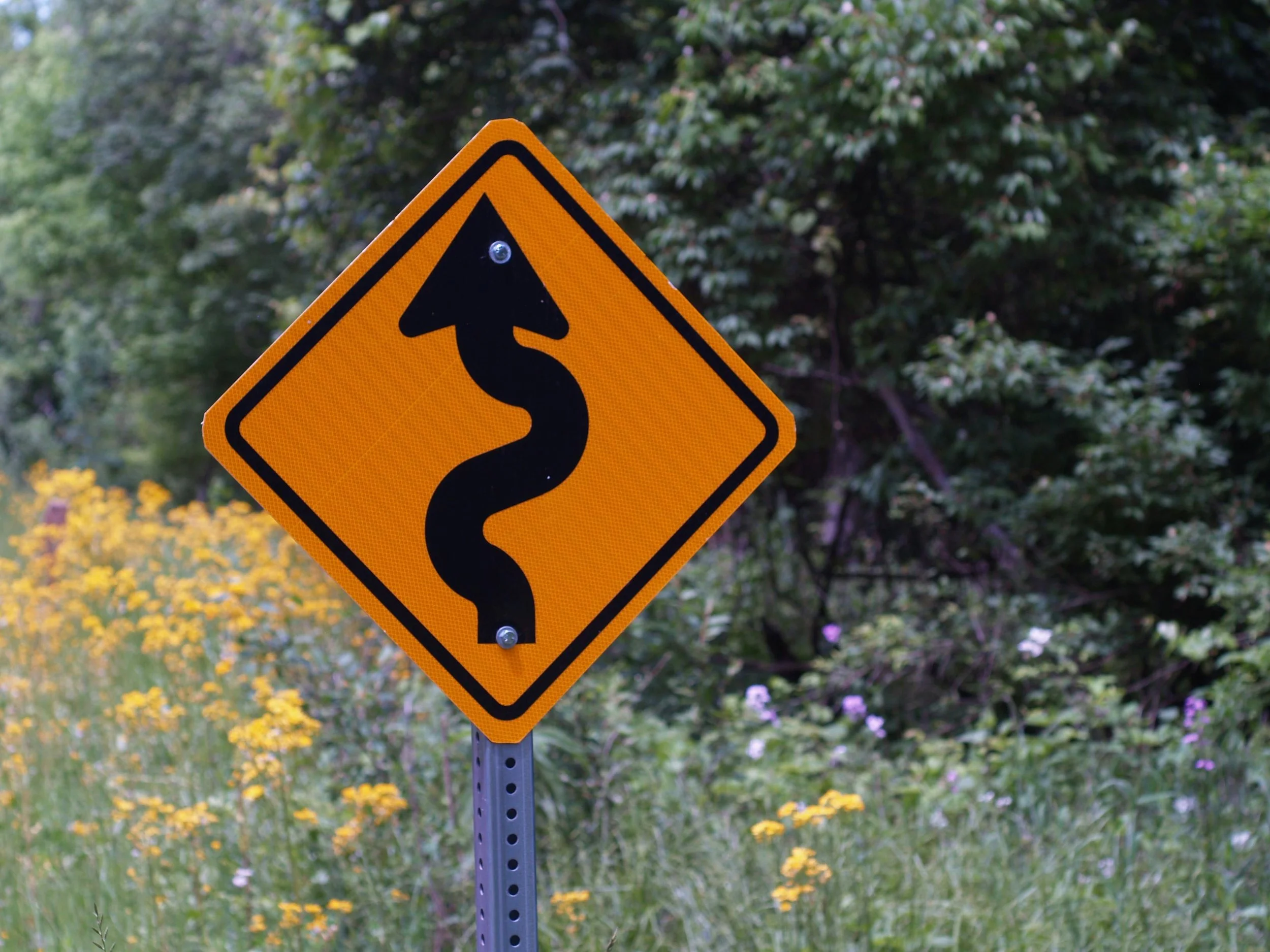
Foreground: Orange, diamond-shaped road sign with black, curvy arrow. Background: Trees and wildflowers.
I was recently asked to be a key note speaker at an autism conference. They asked me to discuss the topic of transitions. I focused on the fact that while services for children are often readily available, most of those services go away when the individual transitions to adulthood. I encouraged them to focus on how to teach coping and support skills in ways that ensure the individual and/or their caregiver can manage those small and large transitions. I then shared a time in my own life when I struggled the most with a major life transition in order to highlight what this looks like. I also answered questions openly about continued struggles with transitions.
One of the things I shared was how much anxiety I had had traveling to the conference. What I didn’t share was how much this difficulty caught me off guard. I have traveled before, I have gone to new places before, I have rented a car before, done public speaking engagements, etc., so I should have been fine. Instead, I was physically ill the whole day I traveled to the conference. I realized later that while I had done all of these things before, I hadn’t travelled by myself for about 20 years. Even if I was traveling with one of my children when they were infants, having another human with me acts like a buffer for my anxiety. I realized that while I have been part of the process of renting a car, I had never actually driven a rental car before because my husband gets car sick and always drives. I had also never been a key note speaker before, which felt really intimidating.
When I shared how much I had struggled, the audience seemed surprised. One of the organizers even apologize to me, but I didn’t share my struggles to gain sympathy, I shared to highlight an important fact. Transitions are hard for autistic people because of the way our brains are wired. We can gain self-regulation tools, find a number of coping strategies, but transitions will never not be difficult for us. I shared because autistic people need their support systems to understand this fact, and to be empathetic towards us when we are struggling. For me, I know the next time I travel to be a key note speaker, it will be a lot easier. I also know that I will have some other transition in the future that makes me so anxious I feel sick. That’s just an unavoidable fact. I am thankful that I have a support system that knows this too, and does well being empathetic, giving me space when needed, but also pushing me a little when I need it. While I might still be anxious, with the right support I can do things that are difficult for me. While all autistic people are different, one fact is consistent, with the right supports, we can do more. So ask yourself, “How I can help the autistic person in my life better navigate those pesky transitions?”